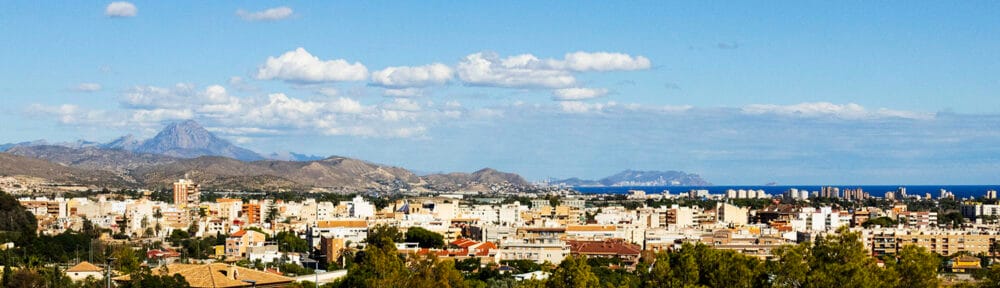
Muchamiel in Valencia, officially Mutxamel (Spain), is a municipality in the Valencian Community of Spain. It is located in the northern part of the Alicante metropolitan area, in the province of the same name and in the Campo de Alicante region. It has 29,256 inhabitants (2023 data).
Location:
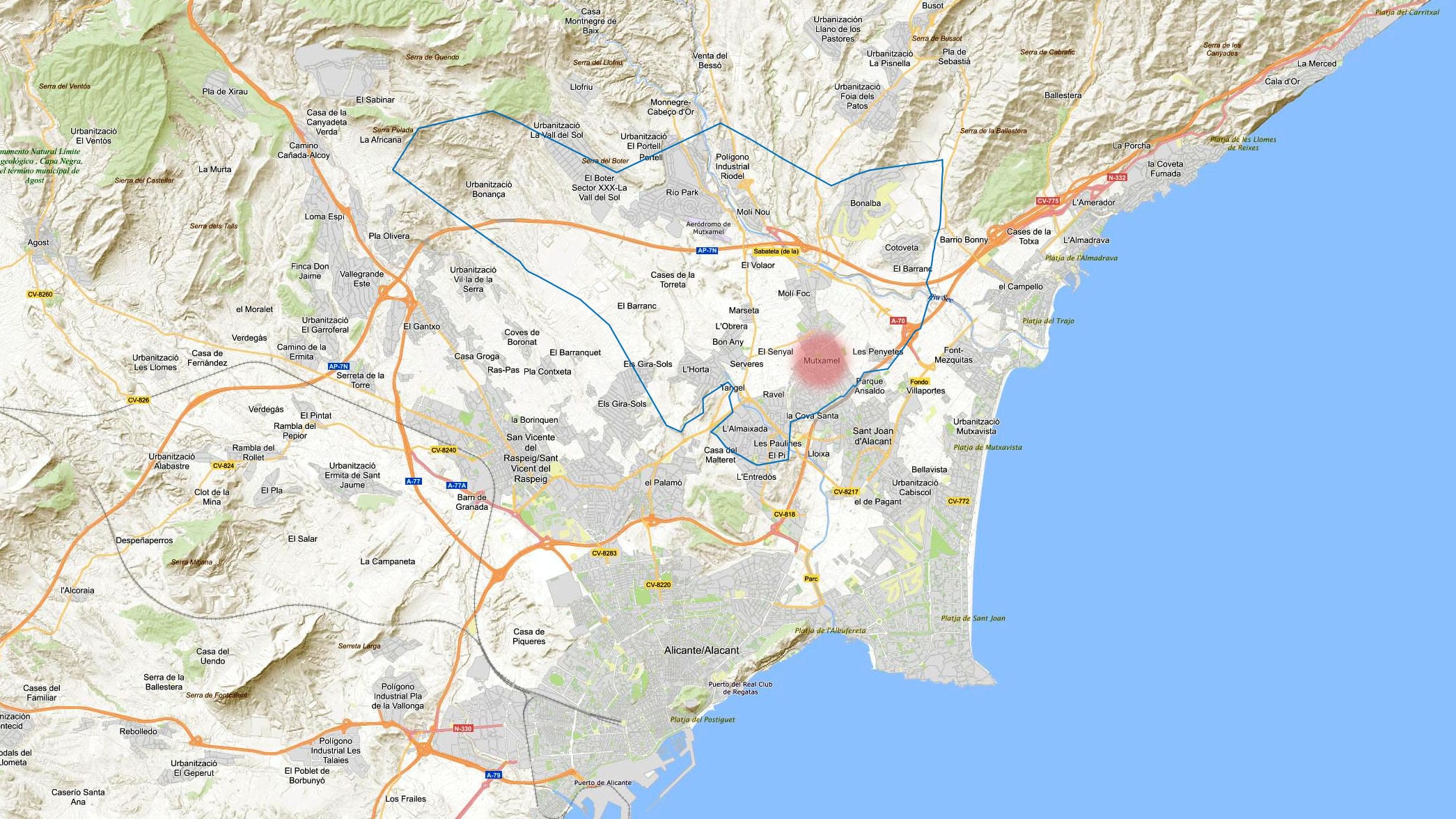
Mutxamel is located in the subregion Huerta de Alicante, 8 km northeast of the city of Alicante and less than 1 km from the neighboring town of San Juan de Alicante. The municipality covers 47.7 km² and is crossed by the Monnegre and Seco rivers, the latter historically important for the town’s development.
It borders directly with Alicante, San Juan de Alicante, San Vicente del Raspeig, El Campello, and Busot.
History:
During the Christian colonization, Mutxamel belonged to the royal family of Alicante and remained under the Crown of Castile for about 50 years, until in 1296 it became part of the Kingdom of Valencia under the rule of James I the Just. Its parish church began construction in 1511.
At the end of the 16th century, the Tibi reservoir was built, which regulated the waters of the Monnegre River and allowed significant development of agriculture and orchards, sustaining the town. As a result, in 1580 it received the title of “University” (granting some municipal independence), and by royal privilege in 1628 it was separated from Alicante and elevated to a town by vote in the kingdom’s Cortes; it voluntarily returned to Alicante in 1653, separating definitively in 1736.
During the War of Succession, it was plundered by the troops of Archduke Charles of Austria.
From the 18th century, many wealthy families from Alicante established their second homes in Mutxamel; over time, French, English, and Italian nobility also settled, attracted by the climate and farmland. These wealthy families bought the best agricultural land and built beautiful buildings, palace-houses, or simply recreational villas. From one of these palaces, Peñacerrada, Mutxamel became an independent municipality in 1789 (currently located in the northern urban area), though it was reintegrated in 1846.
In the district of Mutxamel, French troops of Sucheta were defeated in 1812 by General Roche’s army, then governor of Alicante.
Mutxamel was not urbanized until 1928, when the city council purchased land east of the town center to open several streets toward the current La Rambla street; the new part of the town was designed with a simple street layout, unlike the traditional sector.
During the Second Republic, it was an overwhelmingly conservative town, given the importance of Catholic tradition among the population. However, during the Civil War, Mutxamel remained in Republican territory. Republican authorities did not conduct purges or imprisonments, and from 1937 the Catholic cult returned to the streets with the traditional offering to the Virgin of Loreto. After the war, a leftist purge was carried out, though milder than in other parts of the province. Notably, one of the mayors during the transition, Francisco Bernabeu Alberola, was elected mayor in democracy from 1995 to 1999, after which the socialist Asunción Llorens took office.
Between 1889 and 1969, the municipality was connected by tram to the city of Alicante. Proximity to the capital was decisive for its economy and demographics; since the mid-20th century, the municipality has been integrated into the metropolitan area centered on Alicante.
Views: 8